When a heat exchanger starts costing production time
Fouling, leakage, rising pressure loss, and falling efficiency signal that a plate heat exchanger is putting plant uptime at risk. If damaged plates remain in service, a manageable maintenance issue can become an unplanned shutdown, lost production, and an emergency repair.
In Energy plants, repeated temperature changes, pressure cycles, water chemistry, and suspended solids can weaken plates. Deposits restrict flow; corrosion, pinholes, distortion, or failed gaskets can cause cross-contamination. Cleaning cannot repair a lost pressure boundary. Targeted replacement is often the faster route to a stable restart. Fosters Energy helps plant teams make this decision with engineering discipline.
Why plate condition drives downtime
Replacing only defective plates can reduce outage scope while restoring heat-transfer surface and sealing integrity. The plate sequence, gasket condition, compression, and test results still need control; otherwise the unit may return with repeat leakage or performance loss. That is why industrial plate heat exchanger plate replacement services focus on the cause of recurring stoppages, not simply restarting equipment.
Plate replacement service: a controlled process
Assessment and cleaning
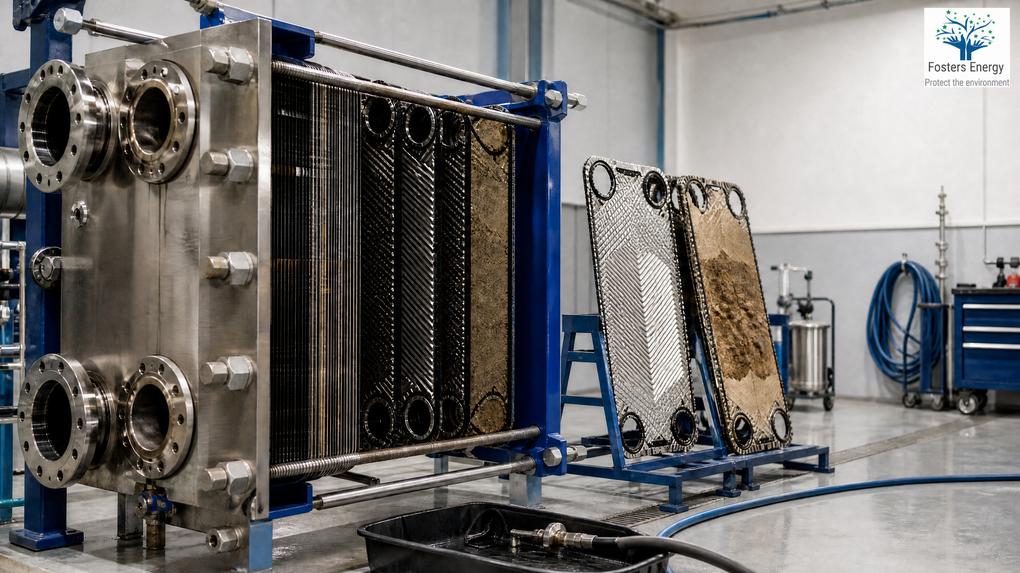
- Dismantling: Isolate and open the exchanger, recording plate order and condition to prevent reassembly errors.
- High-pressure and chemical cleaning: Remove deposits with suitable methods to restore channels and heat transfer.
- Dye penetrant inspection: Identify cracks, pinholes, and surface defects before hidden damage causes a new leak.
Corrective work and testing
- Plate replacement and re-gasketing: Renew defective plates and worn gaskets to protect the pressure boundary and reduce cross-leakage.
- Reassembly and hydrostatic testing: Rebuild the pack to the correct arrangement and compression, then test it before return to service for a more reliable restart.
The downtime-reduction business case
Planned plate replacement lets the work fit a maintenance window instead of a forced outage. For ROI planning, a 10% recovery in thermal performance and one avoided eight-hour shutdown are useful benchmarks; actual value depends on heat duty, energy cost, and the plant’s hourly outage cost. The calculation is straightforward: avoided outage, emergency maintenance, and energy-loss costs, less planned service cost.
- Reduced downtime: Defined scope and documented work support a faster return to service.
- Lower operating cost: Clean channels and sound plates reduce heat-transfer losses and repeat interventions.
- Extended equipment life: Inspection and testing address damage before it spreads through the pack.
Choose an engineering partner, not just a contractor
Successful replacement is more than changing plates. It requires condition assessment, disciplined execution, inspection records, and testing that gives maintenance and procurement teams confidence in the restart. Our engineering approach treats replacement as a managed reliability intervention—not a contractor-only plate change. For a planned assessment, Talk to our engineers. You can also Download company profile & technical documents for your maintenance review.