When Heat Recovery Falls Short, Engineering Design Protects Your Energy ROI
A shell-and-tube heat exchanger can look like a standard item on a plant equipment list—until rising outlet temperatures, unstable process conditions, or repeated shutdowns reveal that the original heat-transfer duty no longer matches the operation. Every lost degree can increase fuel use, limit production, and accelerate equipment stress. Ignoring the gap can turn a design issue into an expensive reliability problem.
Fosters Energy approaches shell-and-tube heat exchangers as engineered energy assets, not one-size-fits-all hardware. The design begins with the actual duty: fluid properties, flow rates, temperatures, pressure limits, fouling risk, materials, maintenance access, and the cost of lost production. The result is a heat-transfer solution selected for the process and its commercial priorities.
What Shell-and-Tube Heat Exchangers Do
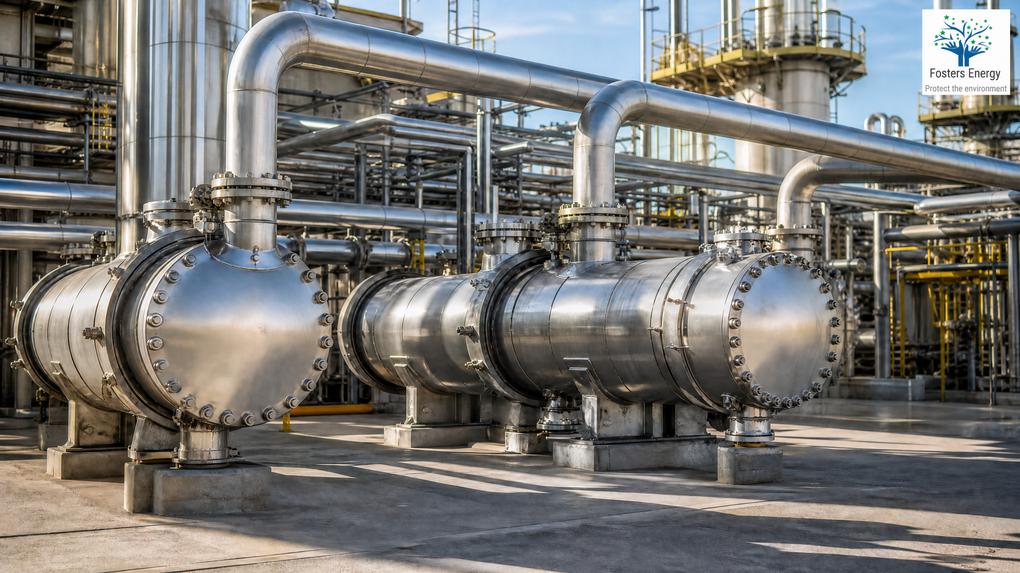
Inside the exchanger, one fluid flows through tubes while another moves around them in the shell. Heat passes through the tube walls without the two fluids mixing. This simple, robust arrangement makes it suitable for heating, cooling, condensing, and heat recovery where stable performance and long service life matter.
Where Energy Plants Use Them
Common applications include boiler-feedwater preheating, lube-oil cooling, process-water heating, steam condensation, fuel and thermal-fluid systems, and waste-heat recovery. In each case, the engineering objective is practical: recover useful heat, control operating temperatures, and reduce the energy required to maintain production.
Why Engineering Design Changes the Payback
Correct sizing and configuration help balance thermal effectiveness against pressure drop, pumping cost, fouling allowance, materials compatibility, and future maintenance. That balance protects efficiency without creating a hidden operating penalty. It also supports more predictable cleaning intervals and reduces the risk of an exchanger becoming the bottleneck in a critical system.
For an illustrative ROI case, a design that recovers 500 kW of otherwise wasted heat for 6,000 operating hours per year offsets 3,000 MWh annually. At an assumed energy value of $0.08/kWh, that represents $240,000 in gross annual energy value before maintenance and installation costs. The same design review should establish site-specific targets for thermal performance, pressure drop, availability, and avoided downtime rather than relying on catalogue ratings alone.
- Lower operating cost: useful heat recovery can reduce fuel or electrical demand.
- Reliable performance: duty-based design supports stable temperatures and production conditions.
- Longer equipment life: suitable materials and controlled operating loads help limit premature damage.
- Reduced downtime exposure: maintainable layouts make inspection and cleaning easier to plan.
- Better procurement decisions: lifecycle value is assessed alongside purchase price.
Make the Heat-Transfer Investment Work Harder
For engineering solutions for energy plants, connect exchanger design decisions with efficiency, reliability, and lifecycle cost. Talk to our engineers about your operating duty, or download company profile and technical documents to support your next evaluation.