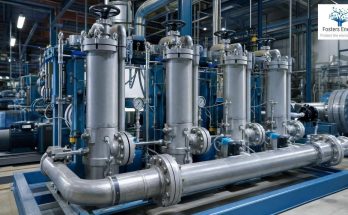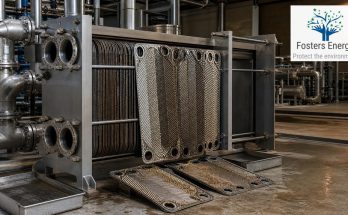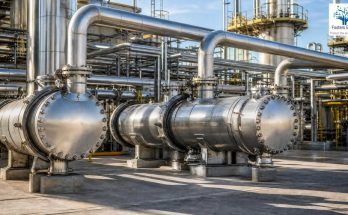
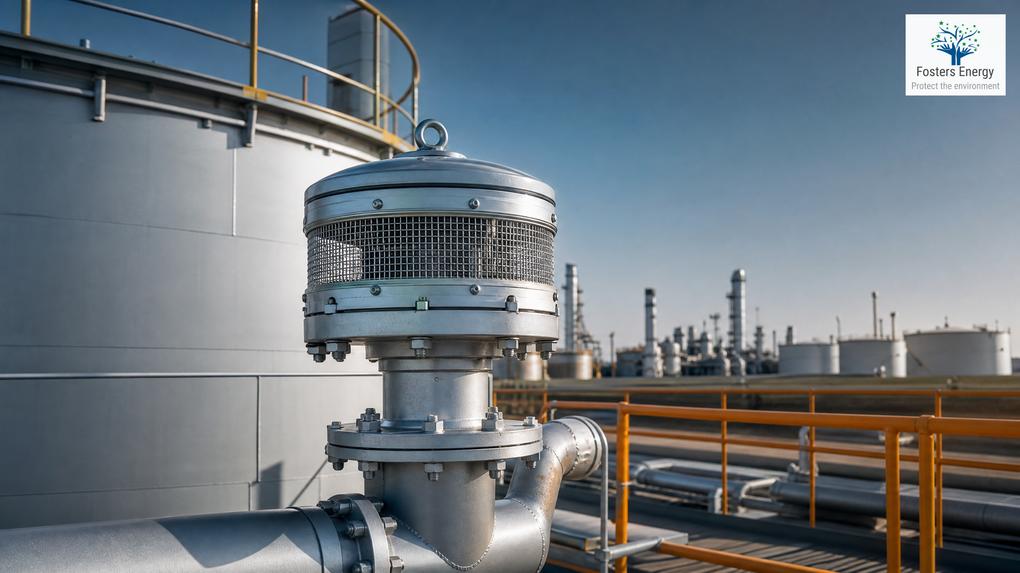
PPE is essential on every energy site, but it cannot stop a flame travelling through a tank vapour line. When a flame arrestor is missing, poorly selected or difficult to maintain, a small ignition event can become fire propagation, equipment damage, emergency shutdown and lost production.
Fosters Energy treats Flame Arrestor and Tank Equipment as an engineering design decision—not a last-minute hardware purchase. The goal is to manage tank safety risk while protecting reliability, maintainability and operating cost.
What Flame Arrestor and Tank Equipment Does
A flame arrestor is designed to stop a flame from travelling through a vapour path while allowing the tank system to breathe as intended. When selected for the actual tank service, venting arrangement and operating conditions, it creates a practical barrier between a potential ignition event and the stored medium.
Associated tank equipment supports the same safety objective by helping manage vapour movement, pressure and routine operation. The benefit is more than protection after an incident: it is a better-engineered installation that reduces exposure before an incident occurs.
Where It Supports Energy Operations
Flame arrestors and tank equipment are relevant to fuel storage, hydrocarbon handling, process tanks and other energy-plant applications where flammable vapours may be present. The correct arrangement depends on tank design, fluid characteristics, connection layout, flow requirements and access for inspection and maintenance.
Why Engineering Design Matters
A component that is suitable in isolation can still create pressure loss, inspection difficulty or an unreliable protection path when poorly integrated. An engineering-led approach reviews the complete operating context, so safety measures do not become a hidden source of inefficiency or avoidable downtime.
The ROI case should be measured against the plant baseline. If engineered protection prevents one 24-hour unplanned shutdown, the downtime reduction is 24 hours; multiply those recovered hours by the site’s lost-production cost per hour to calculate avoided cost. Track tank-related maintenance hours, inspection time and operating performance before and after the design review to calculate the site-specific improvement percentage rather than relying on generic promises.
- Reduced fire-propagation risk: adds a controlled protective barrier in vapour paths.
- More reliable operation: supports dependable tank breathing and plant availability.
- Lower lifecycle cost: considers access, inspection and maintainability before installation.
- Less downtime exposure: helps prevent a tank-safety issue from becoming an emergency shutdown.
- Safer engineering decisions: aligns equipment selection with the real energy application.
For practical support, review the industrial flame arrestor and tank equipment services available for energy-plant requirements. Talk to our engineers or download company profile and technical documents to begin an informed design review.