When Cooling-Water Reliability Is at Risk
Biofouling, blocked seawater intakes and unstable cooling-water treatment can quietly reduce heat-transfer performance before they trigger a plant shutdown. For an energy facility, that means higher auxiliary power use, rising maintenance pressure and a greater risk of lost generation.
Fosters Energy helps energy-sector operators address this risk with Electro Chlorination Packages designed around dependable, on-site disinfection and practical operating efficiency.
What Electro Chlorination Packages Do
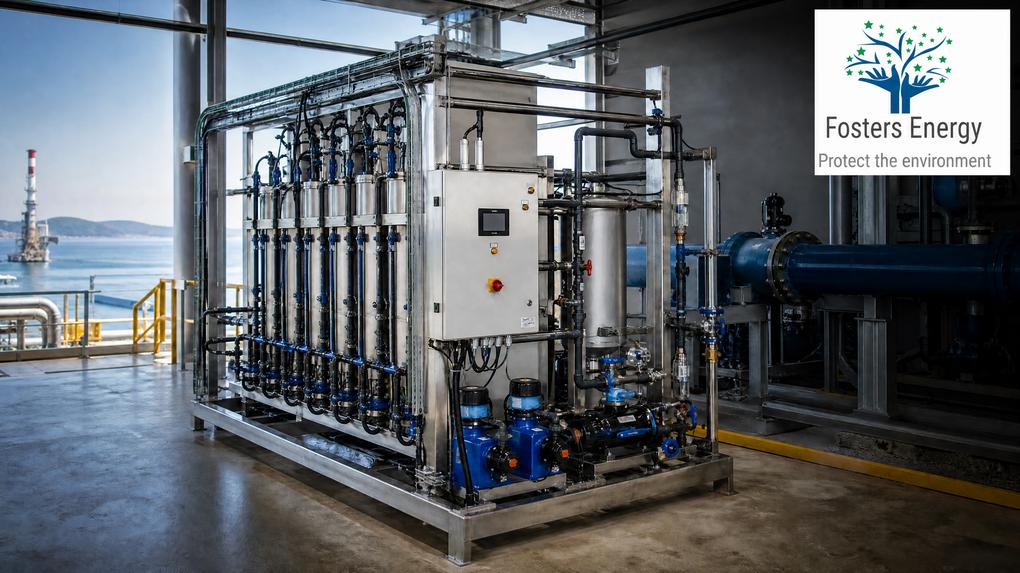
An Electro Chlorination Package generates a dilute hypochlorite solution on site by applying controlled electrolysis to seawater, brine or saltwater feed. The solution is dosed into cooling-water circuits to control marine growth and biological fouling where it starts: in intake systems, condensers and associated process-water equipment.
Because treatment is produced close to the point of use, the plant can reduce dependence on delivered chemical supply, long storage periods and the handling risks associated with bulk disinfectants. More consistent treatment helps protect heat-transfer surfaces and keeps critical cooling systems available for duty.
Where It Supports Energy Operations
These packages are suited to coastal power stations, desalination and water-and-power facilities, refineries, and other energy plants that rely on seawater or brackish-water cooling. They can support intake channels, screening systems, cooling-water lines and condenser circuits where biological growth can increase pressure loss and reduce thermal performance.
Reliability and Efficiency in Business Terms
Reliability improvement is the commercial value. Cleaner water paths help maintain stable flow and heat transfer, reducing the chance that operators must derate equipment or schedule disruptive corrective work. The right dosing strategy also avoids treating every operating condition as a peak-demand event.
As a planning example, a site using 1,000 kWh per day for electrochlorination could save approximately 200–400 kWh per day from a 20–40% reduction during lower-demand periods. At $0.10 per kWh, that is about $7,300–$14,600 per year, before counting the value of avoiding even one eight-hour cooling-water interruption. Actual results depend on water chemistry, plant duty, environmental limits and control philosophy, so the baseline should be verified during engineering review.
Key Benefits
- More dependable biofouling control for cooling-water assets.
- Lower energy and chemical-supply exposure through site-based generation.
- Fewer emergency interventions caused by blocked or degraded water paths.
- Improved condenser and heat-transfer reliability, supporting stable plant output.
- Lower lifecycle cost through better control of maintenance and downtime risk.
Choose an Engineering-Led Solution
Electro Chlorination Packages deliver the greatest value when capacity, dosing, monitoring and operating conditions are matched to the facility—not treated as a one-size-fits-all purchase. Explore our engineering solutions for electro chlorination packages in energy plants and discuss the reliability priorities behind your project.
Talk to our engineers about improving cooling-water reliability, or download company profile and technical documents for further evaluation.