
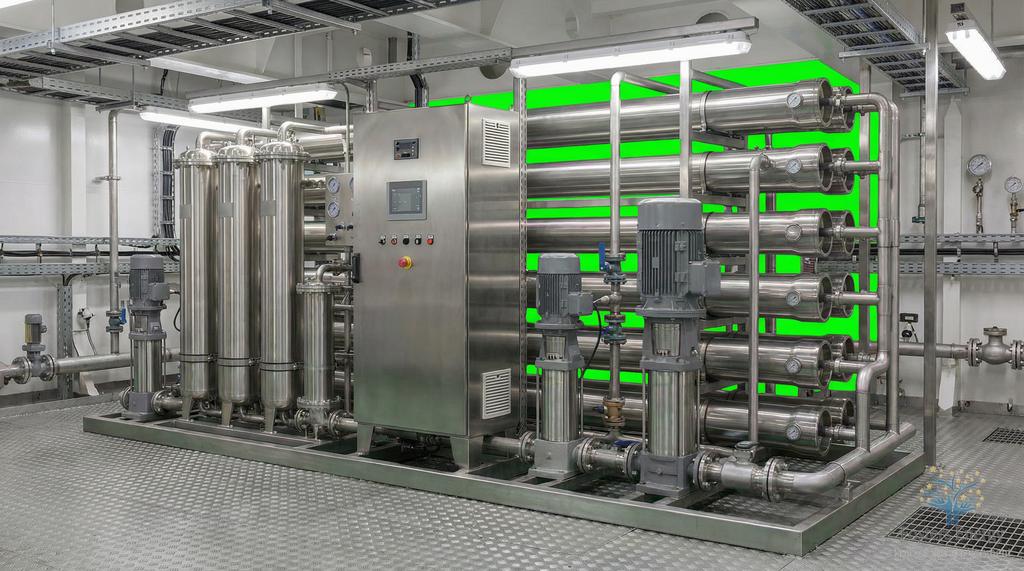
Reverse Osmosis (RO) Water Generator for Marine Operations: Industrial Innovation for Reliable Fresh Water Supply
Fresh water production is no longer a secondary utility on modern vessels. It is a core operational requirement that affects crew welfare, machinery support functions, hotel services, and voyage autonomy. Ships operating across long routes cannot depend solely on stored potable water because tank capacity is limited, resupply schedules vary by port, and the cost of loading treated water at terminals can become significant over time. In marine environments, operators also face changing seawater salinity, temperature variation, suspended solids, biological activity, and pressure on space and energy consumption. These conditions make on-board water production a technical issue rather than a simple convenience. A well-engineered Reverse Osmosis (RO) Water Generator addresses this challenge by converting seawater into usable fresh water through controlled membrane separation, supporting stable daily operations with a predictable treatment process.
For marine owners, technical managers, and procurement teams, the innovation value of a Reverse Osmosis (RO) Water Generator lies in its ability to combine water quality control, compact system integration, and operational efficiency in a single package. Instead of relying on traditional methods alone, marine RO technology uses pressure-driven separation to remove dissolved salts and a broad range of impurities from feedwater. This approach provides a practical route to consistent fresh water production on commercial vessels, offshore support units, and marine service platforms. As an engineering solutions provider with experience in flow equipment, thermal systems, and separation technologies, Fosters Energy positions this equipment within a broader operational framework focused on reliability, maintainability, and long-term service value.
Technical Challenge
Fresh water demand under marine operating constraints
Marine vessels consume fresh water continuously for drinking, cooking, sanitation, cleaning, technical washdown, and selected machinery-related uses. The challenge is that demand is steady while operating conditions are not. Feedwater characteristics can change with geography, harbor traffic, coastal contamination, seasonal temperature, and biological loading. At the same time, engine room layouts restrict equipment footprint, vibration can affect installation design, and operators expect systems to function with limited intervention during voyage conditions. A water generation system must therefore perform under variable salinity, fluctuating seawater temperature, and changing intake quality without creating excessive maintenance burden.
Pressure, fouling, and membrane protection
RO systems are effective because they apply pressure high enough to overcome the osmotic pressure of seawater and force water molecules through semi-permeable membranes while rejecting salts. However, this same principle creates a technical balance that must be carefully managed. If pre-filtration is inadequate, suspended solids and organic matter can foul membrane surfaces. If scaling potential is not controlled, dissolved minerals can precipitate and reduce membrane efficiency. If hydraulic design is poor, operators may face unstable flow, declining permeate rate, or higher energy use. In marine service, the challenge is not merely to produce water once; it is to sustain water quality and production rate across changing voyage conditions while protecting key components such as high-pressure pumps, cartridges, and membrane elements.
Operational risk of unreliable water production
When fresh water generation becomes inconsistent, the consequences extend beyond inconvenience. Operators may need to ration use, alter housekeeping schedules, or depend on port-side water supply with associated cost and logistical limitations. Unstable water production can also complicate vessel planning on longer passages where replenishment opportunities are limited. For technical teams, every drop in permeate flow or rise in differential pressure is a sign that hydraulic conditions, pretreatment performance, or membrane condition may be moving outside the desired operating window. This is why marine buyers increasingly evaluate RO units not only by nominal capacity, but also by system design, maintainability, and suitability for real operating conditions.
Engineering Solution
Integrated seawater-to-fresh-water treatment
The engineering value of a marine Reverse Osmosis (RO) Water Generator comes from integrating intake conditioning, pressure generation, membrane separation, and post-treatment into one coordinated system. Seawater is first drawn from the vessel’s source line and passed through pretreatment stages intended to reduce particulate loading and protect downstream components. A high-pressure pumping section then raises feed pressure to the range required for seawater membrane operation. Inside the membrane array, purified water permeates through the membrane while concentrated brine is rejected. The permeate stream is then directed to post-treatment and storage, depending on vessel water quality requirements and downstream distribution design.
Innovation through compact design and process control
Industrial innovation in marine RO systems is not defined by novelty alone. It is defined by measurable improvements in how equipment performs in limited space, under motion, and with variable feed conditions. A modern system is designed to reduce unnecessary footprint, streamline pipe routing, support maintainable access to filters and membranes, and provide operating visibility through gauges, alarms, and control interfaces. This engineering approach allows the crew to monitor pressure trends, flow behavior, and water quality parameters before performance loss becomes severe. In practice, a well-configured marine RO water generator turns a difficult utility service into a manageable, predictable process system.
Alignment with broader vessel efficiency objectives
Shipowners increasingly evaluate technical equipment based on total operational effect rather than isolated purchase cost. A properly selected RO water generator supports this objective by reducing dependence on externally supplied fresh water, improving voyage flexibility, and helping operators manage consumables and storage more efficiently. When integrated with a practical maintenance plan, the system supports long service life for membranes and associated components. This makes RO technology a relevant innovation pathway for marine operators seeking better utility resilience without unnecessary complexity. Through its engineering-led approach, Fosters Energy can support the selection of marine systems that align with both equipment performance and day-to-day operating realities.
Product Explanation
How a Reverse Osmosis (RO) Water Generator works
A Reverse Osmosis (RO) Water Generator removes dissolved salts from seawater by using semi-permeable membranes and pressure-driven separation. Natural osmosis would normally cause water to move toward the higher-salinity side of a membrane. Reverse osmosis applies external pressure greater than the osmotic pressure of seawater, forcing water in the opposite direction through the membrane while leaving most dissolved salts and many contaminants behind. The result is a permeate stream of fresh water and a reject stream carrying the concentrated salts.
In marine duty, the process typically includes feedwater intake, pretreatment filtration, high-pressure pumping, membrane separation, permeate collection, reject discharge, and post-treatment. Pretreatment is critical because the membrane is the core separation component and must be protected from excessive solids and fouling load. The high-pressure section is equally important because it determines whether the system can consistently achieve the pressure needed for effective desalination. Post-treatment may include conditioning steps depending on intended use, tank materials, and shipboard water management practice.
Main functional components
- Seawater feed connection and inlet control components for stable supply.
- Pretreatment filtration to reduce suspended solids and protect membranes.
- High-pressure pump section sized for marine seawater RO duty.
- Membrane housings and membrane elements for salt rejection and fresh water production.
- Instrumentation for monitoring pressure, differential pressure, flow, and operating condition.
- Control panel and protection logic for operational management and shutdown response.
- Post-treatment or conditioning section as required by vessel water specification.
What makes the product suitable for marine use
A marine RO unit must do more than desalinate water. It must remain serviceable in compact machinery spaces, tolerate continuous operation patterns, and support maintenance by vessel technical staff or service teams. Practical suitability depends on robust frame construction, rational component arrangement, and access for routine servicing of filters, pump seals, and membrane modules. It also depends on correct sizing relative to daily demand, crew complement, duty cycle, and expected feedwater conditions. A well-matched Reverse Osmosis (RO) Water Generator allows the vessel to produce fresh water with better independence from shore supply, while giving operators a clearer process route for inspection, cleaning, and replacement of consumable elements.
Benefits
Reduced dependence on port water supply
One of the most direct benefits is lower dependence on loading fresh water in port. This improves operational flexibility and can reduce the cost exposure associated with shore-based water procurement. For vessels on longer routes or irregular service patterns, on-board RO generation supports better planning and more stable utility management.
Consistent water quality through controlled treatment
Because the treatment process is based on membrane separation and monitored operating conditions, RO systems can deliver a more controlled water production process than unmanaged supply alternatives. With correct pretreatment and routine maintenance, the system helps maintain a stable standard of fresh water quality suitable for marine use requirements.
Compact and efficient system integration
Marine engine room and service areas always impose layout constraints. A properly engineered RO package offers a compact method of producing fresh water without requiring excessive tank expansion or separate treatment complexity. This is particularly important when operators need dependable utility performance but cannot sacrifice large areas of valuable onboard space.
Maintainability and lifecycle value
From an engineering perspective, long-term value depends on how easily the unit can be inspected, cleaned, and restored to operating condition. Filter service, pump checks, membrane cleaning strategy, and instrumentation review all affect lifecycle performance. A marine RO unit that is logically designed and supported with service knowledge provides better maintainability, lower disruption risk, and more predictable operating cost over time.
Applications in Marine
Commercial vessels and working fleets
Commercial ships, support vessels, and workboats require reliable fresh water production to sustain crew services and routine operations. In these applications, an RO Water Generator supports voyage continuity and reduces logistical dependence on shore water availability.
Offshore support and extended-duty operations
Offshore support vessels and other units working away from frequent resupply points benefit from on-board desalination because the utility demand is continuous while replenishment opportunities may be limited. RO systems provide a technical means to maintain fresh water availability without disproportionate storage dependence.
Marine systems with integrated utility management
Where vessels are managed with broader efficiency and reliability targets, fresh water generation becomes part of the wider utility strategy. The RO unit can be considered alongside pumps, filters, valves, and thermal equipment as part of an integrated marine engineering approach. This is where supplier capability matters: the system should not be treated as isolated hardware, but as a functional element in a working marine process environment.
- Cargo and merchant vessels requiring dependable daily potable water production.
- Support vessels operating on routes with limited port-side water access.
- Service fleets seeking compact utility systems with practical maintenance access.
- Marine operations where lifecycle reliability and system efficiency are procurement priorities.
Why Fosters Energy
Engineering-oriented supply approach
Fosters Energy is positioned as an engineering solutions provider rather than a simple trader of industrial equipment. The company’s published profile emphasizes experience in flow equipment, thermal exchangers, separation technologies, spare parts sourcing, energy audit, and service audit. That background is relevant to marine RO applications because reverse osmosis performance depends on a combination of hydraulic control, component compatibility, and maintainable system design. A supplier with engineering awareness is better placed to connect the product to actual onboard operating conditions.
Marine-relevant product portfolio
The company’s marine portfolio includes equipment categories related to water, heat transfer, pumping, valves, filters, and associated systems. This matters because a Reverse Osmosis (RO) Water Generator does not operate in isolation. It interacts with vessel piping, intake quality, pumping reliability, filtration performance, and maintenance planning. A broader marine solutions perspective helps ensure that the product is selected with attention to service environment and supporting components, not only nameplate capacity.
Support for practical operational performance
For shipowners and technical managers, the most useful supplier relationship is one that supports application fit, maintainability, and operating continuity. That means understanding the vessel’s fresh water demand, feedwater profile, available footprint, service access, and expected maintenance routine. Fosters Energy can be positioned in that role: a partner helping marine operators source technically relevant systems with attention to real equipment duty rather than generalized sales language.
Conclusion
In marine operations, a reliable fresh water source is an operational necessity tied to voyage planning, crew support, and technical continuity. The Reverse Osmosis (RO) Water Generator represents an important industrial innovation because it converts seawater into usable fresh water through a controlled, pressure-driven separation process that suits modern onboard utility needs. When engineered correctly, the system provides a practical response to limited storage, variable operating conditions, and the need for consistent water production at sea.
For marine stakeholders evaluating desalination equipment, the decision should focus on more than capacity alone. Pretreatment, pressure stability, membrane protection, maintainability, and supplier engineering capability all influence long-term performance. Within that framework, Fosters Energy offers relevant value by connecting marine equipment supply with broader expertise in flow, thermal, and separation technologies. A properly selected Reverse Osmosis (RO) Water Generator can help vessels improve operational independence, utility reliability, and lifecycle efficiency in demanding marine environments.