DX Evaporator Reliability Improvement in Marine Systems
In marine service, cooling reliability is a functional requirement rather than a comfort feature. A vessel depends on stable thermal control to support accommodation spaces, technical rooms, refrigerated areas, and utility systems that must keep operating under variable ambient temperature, fluctuating load, vibration, and restricted access for maintenance. When a DX Evaporator begins to lose performance, the effect is rarely limited to one cabin or one localized cooling duty. It can trigger unstable temperature control, rising compressor runtime, irregular frosting, poor humidity management, and a gradual increase in service intervention. For operators working to fixed schedules, these deviations translate into operational risk, higher energy demand, and reduced confidence in the wider refrigeration or air-conditioning circuit.
A properly selected DX Evaporator improves reliability by creating a more stable heat absorption zone inside the direct expansion system. In practical terms, the evaporator must do more than provide nominal cooling capacity on a catalog sheet. It must support even refrigerant distribution, dependable airflow, proper condensate removal, and maintainable access in a marine environment where corrosion exposure, humidity, salt contamination, and motion can shorten the service life of poorly matched equipment. This is why marine operators increasingly evaluate the evaporator not only as a cooling component, but as a reliability-critical part of the complete system.
From an engineering perspective, reliability improvement depends on how the evaporator performs over time under real vessel conditions. The objective is to preserve heat transfer quality, prevent avoidable stress on the compressor and controls, and reduce unplanned disruption. Through its marine product portfolio and engineering-oriented approach, Fosters Energy supports marine operators that need thermal equipment selected with operating reality in mind rather than generic supply assumptions.
Introduction
Direct expansion cooling is based on a simple principle: refrigerant absorbs heat inside the evaporator coil, changes phase from liquid to vapor, and then transfers that heat through the remaining parts of the refrigeration cycle. Although the principle is straightforward, reliable operation at sea is not. Marine systems are exposed to high moisture levels, confined machinery spaces, vibration, vessel motion, intermittent load changes, and maintenance windows that are often tighter than in shore-based facilities. Under these conditions, even a moderate decline in evaporator performance can spread quickly through the whole cooling circuit.
The DX Evaporator is the location where useful cooling is actually created. If this part of the system performs well, air-side heat transfer remains stable, suction conditions stay more predictable, and the overall system can respond to changing demand with less stress. If it performs poorly, the result may include coil fouling, poor refrigerant distribution, condensate problems, icing, and excessive compressor cycling. Reliability improvement therefore starts by understanding the evaporator as a critical engineering component rather than an interchangeable accessory.
Technical Challenge
Why marine conditions create higher reliability demands
A marine DX system must keep working while exposed to operating factors that commonly accelerate performance loss. Salt-laden air can increase the risk of corrosion around metal surfaces and nearby components. High humidity can intensify condensation load and make drainage quality more important. Motion and vibration can affect long-term stability if the installation arrangement is not robust. Space limitations can restrict airflow paths, service access, and pipe routing. These factors influence how effectively the evaporator can transfer heat and how easily it can be inspected and maintained.
In many cases, reliability issues do not begin with complete failure. They begin with small but significant deviations. A coil may accumulate contaminants and lose air-side efficiency. Refrigerant distribution may become uneven across the circuits, reducing the active heat transfer area. Drain arrangements may not manage condensate effectively during varying vessel motion. Fan performance may drift below the intended operating point. Individually, each problem may seem manageable. Together, they can create unstable superheat behavior, inconsistent cooling capacity, and rising stress across the refrigeration loop.
Common symptoms that indicate evaporator-related reliability loss
Marine engineers often identify DX evaporator problems through operating symptoms before a hard shutdown occurs. Temperature pull-down may become slower under high load. The compressor may run longer than expected. Frost patterns may appear uneven across the coil face. Drain pans may retain more moisture than intended. Humidity control may worsen in conditioned spaces. Occupants or technicians may report that cooling is acceptable at some times and weak at others. These symptoms are important because they show that the evaporator is no longer maintaining stable heat exchange in a consistent manner.
- Unstable cooling output during changing marine load conditions.
- Longer compressor runtime caused by reduced evaporator effectiveness.
- Localized frosting or icing linked to airflow or refrigerant imbalance.
- Drainage and condensate handling issues in humid vessel environments.
- Higher maintenance frequency due to fouling, inspection findings, or repeated thermal complaints.
Because the evaporator sits at the point where the refrigerant absorbs heat, any weakness in its operation affects the full system. Reliability improvement therefore means stabilizing the evaporator so the compressor, expansion valve, fans, and controls can operate under more predictable conditions.
Engineering Solution
A system-focused approach to evaporator selection
The most effective engineering solution is to match the DX Evaporator to the actual marine duty rather than selecting only by nominal capacity. The coil arrangement, airflow design, drain layout, material quality, and physical footprint must align with the vessel’s operating conditions. A reliable evaporator should support uniform refrigerant evaporation, practical service access, and steady air-side performance under load variation. It should also integrate properly with the expansion device and control strategy so that the system can maintain stable operating conditions instead of constantly correcting for imbalance.
This means the evaporator should be evaluated in relation to the full thermal circuit. If the evaporator is oversized or undersized for the application, system response becomes less stable. If airflow distribution is weak, sections of the coil may not transfer heat evenly. If condensate management is poorly designed, water retention and hygiene problems may develop, especially in humid marine spaces. If maintenance access is too limited, routine cleaning and inspection may be delayed until performance degradation becomes severe. Reliability improves when the product is selected and installed as part of an engineered solution rather than treated as a generic replacement item.
Maintainability is part of reliability
A marine evaporator should not only perform well on day one. It should remain serviceable over time. That requires practical access to the coil face, fan section, drain area, and associated connections so preventive maintenance can be carried out before the cooling duty deteriorates. In vessel applications, equipment that is difficult to inspect often remains in place longer than it should between cleaning intervals. The result is a preventable drop in thermal performance and an increased risk of unplanned intervention. Reliable design therefore includes maintainability, inspection access, and sensible installation discipline.
Fosters Energy addresses these challenges through an engineering solutions model that considers product suitability, system context, and practical operational requirements. For marine operators focused on uptime, this approach is more useful than a supply-only mindset because it ties product selection directly to service performance.
Product Explanation
What a DX Evaporator does
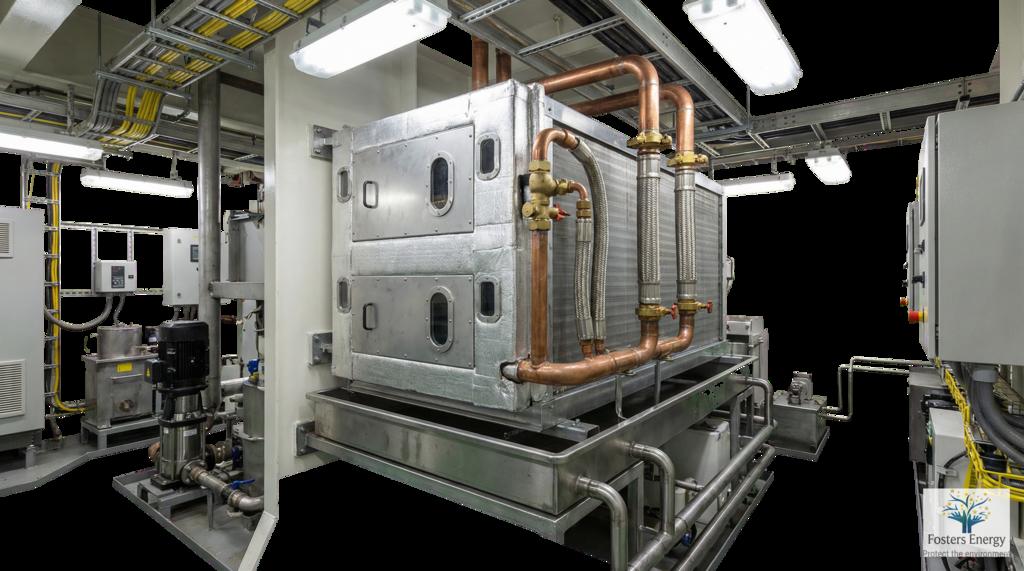
A DX Evaporator is the heat absorption section of the direct expansion refrigeration cycle. Refrigerant enters the evaporator after passing through the expansion device, where pressure and temperature are reduced to allow boiling within the coil. As air moves across the evaporator surface, heat transfers from the air to the refrigerant. The refrigerant then leaves the evaporator as vapor and continues through the system toward the compressor and condenser. This process is fundamental to marine air-conditioning and refrigeration duties because it is where the actual cooling effect is generated.
The reliability of this process depends on how evenly the refrigerant is distributed, how consistently air moves across the coil, and how effectively condensate is removed from the unit. If these conditions remain stable, the evaporator can support predictable suction behavior, better capacity control, and lower stress on upstream and downstream components. If they do not, the evaporator becomes a source of instability that can affect the entire cooling loop.
Why design details matter for marine reliability
In marine environments, evaporator reliability is influenced by more than heat transfer area. Construction robustness matters. Drainage arrangement matters. Access for inspection matters. Integration with the expansion valve and controls matters. The system must withstand shipboard operating realities without drifting into a pattern of repeated minor faults. A DX Evaporator that supports dependable refrigerant flow, stable air-side performance, and practical maintenance access contributes directly to lower downtime risk and better operational continuity.
This is particularly important on vessels where thermal loads may shift with occupancy, weather, equipment operation, and voyage profile. The evaporator must respond cleanly to these changes without creating excessive icing, poor humidity control, or unstable compressor operation. Reliability improvement therefore comes from selecting a product suitable for marine service and integrating it correctly into the overall system.
Benefits
Operational and maintenance benefits of a reliable DX Evaporator
When the DX Evaporator is properly matched to the marine application, the benefits extend beyond immediate cooling performance. The system becomes more stable, maintenance becomes more predictable, and the wider refrigeration circuit operates under lower avoidable stress. For vessel operators, that means fewer disruptions and a more controlled maintenance strategy.
- Improved operating continuity through more stable heat transfer and fewer cooling interruptions.
- Better temperature consistency in accommodation, control, and utility spaces.
- Lower compressor stress because suction conditions remain more predictable.
- Reduced risk of recurring icing, drainage problems, and short-cycle behavior.
- More efficient maintenance planning based on inspection and preventive cleaning rather than repeated reactive service.
These benefits are especially relevant in marine environments where downtime has a direct operational cost and where repeated service intervention can be difficult to schedule. Reliability improvement at the evaporator level supports broader system resilience across the vessel’s cooling duties.
Applications in Marine
Where reliable DX evaporator performance matters most
DX evaporators are used in multiple marine settings where direct refrigerant cooling provides a compact and responsive solution. The exact arrangement may vary by vessel type and service duty, but the operational requirement remains the same: the evaporator must deliver repeatable heat transfer under changing marine conditions.
- Accommodation air-conditioning systems that require stable comfort cooling and humidity control for crew and passengers.
- Technical rooms and control spaces where thermal stability helps protect electrical and instrumentation equipment.
- Galley support, utility, and service zones that depend on predictable cooling capacity in confined onboard spaces.
- Specialized refrigeration duties where responsive heat removal is needed and equipment downtime is highly disruptive.
In each of these applications, the DX Evaporator contributes directly to performance continuity. A reliable unit helps prevent thermal drift, reduces repeated service complaints, and supports the wider operational discipline required on commercial and industrial marine assets.
Why Fosters Energy
Engineering support aligned with marine operating reality
Fosters Energy is positioned as an engineering solutions provider serving thermal, flow, and separation applications across marine and energy sectors. That positioning is important when selecting a DX Evaporator for reliability improvement. Marine cooling performance depends on proper application review, equipment suitability, and practical awareness of onboard operating conditions. A supply decision made without those factors often leads to avoidable performance compromise later in service.
By working from an engineering perspective, Fosters Energy can frame the evaporator not as an isolated component but as part of the thermal system that must perform under real marine constraints. This supports a more credible approach to product selection, maintenance planning, and long-term service value. For owners, operators, and marine maintenance teams, that engineering focus is central to achieving dependable results.
Product relevance within a wider thermal portfolio
The company’s broader marine product offering also matters because evaporator performance is closely linked to the surrounding thermal and flow environment. Operators often benefit when the discussion around reliability includes not only the evaporator itself, but also operating conditions, related equipment, and maintenance expectations. That broader view strengthens decision-making and reduces the chance of selecting a technically mismatched solution.
Conclusion
A DX Evaporator is a core reliability component in marine cooling systems because it is the point where heat is absorbed and where many performance deviations first become visible. In marine service, reliability improvement depends on stable refrigerant distribution, effective airflow, sound drainage, maintainable construction, and correct integration with the wider direct expansion circuit. When these conditions are achieved, operators gain steadier cooling performance, lower avoidable system stress, and a more predictable maintenance profile.
For vessel operators seeking long-term thermal stability, selecting the right DX Evaporator is an engineering decision rather than a routine procurement task. The goal is not simply to cool a space, but to sustain dependable operation in a demanding marine environment. With its engineering-led approach and marine product scope, Fosters Energy provides the right context for evaluating DX Evaporator solutions that support reliability improvement where it matters most: in real onboard service.