Ship Anchors for Operational Optimization in Marine Service
Anchoring is often treated as a basic vessel function until operational performance begins to suffer. In practice, the anchor arrangement influences how quickly a vessel can secure position, how safely the deck team can work, how reliably a ship can hold under changing weather and seabed conditions, and how effectively the operator can avoid unnecessary delays. When anchoring performance is inconsistent, the result is rarely limited to a single deck operation. It can affect berthing windows, offshore standby time, cargo planning, maintenance scheduling, and risk exposure during adverse marine conditions.
For marine operators focused on operational optimization, ship anchors must be evaluated as working equipment rather than passive hardware. Reliable holding performance, controlled deployment, predictable retrieval, structural durability, and compatibility with the vessel’s anchoring arrangement all contribute to efficient marine operations. Fosters Energy supports marine clients with practical engineering supply solutions, helping operators source equipment that aligns with real service conditions rather than generic specification sheets alone.
In commercial fleets, offshore support operations, and harbor service applications, the cost of a poorly matched anchoring setup is measurable. Crews may spend longer establishing secure hold, windlass systems may experience avoidable loading, chain wear may accelerate, and repeated corrective handling may increase safety exposure on deck. A well-selected ship anchor supports operational discipline by reducing variability during anchor deployment and recovery while maintaining dependable seabed engagement across different service profiles.
Introduction
Marine operations depend on repeatability. Whether the vessel is waiting offshore, holding position during transfer support, standing by near port approaches, or managing coastal operations, the anchoring sequence must be executed with confidence. Delays during anchoring can disrupt the wider operating plan, especially when the vessel is working within narrow scheduling windows or in areas where weather, current, and traffic conditions can change rapidly.
Operational optimization in this context is not limited to speed. It includes the ability to deploy the anchor under controlled conditions, achieve holding performance appropriate to the vessel and seabed, minimize excessive movement after set, and recover the system without abnormal mechanical resistance or deck handling complications. The anchor must therefore be considered as part of a broader marine equipment strategy that balances safety, reliability, service life, and vessel efficiency.
As an engineering-focused supplier, Fosters Energy approaches marine products with attention to actual operating demands. For ship anchors, this means supporting solutions that help vessel operators improve anchoring reliability, reduce avoidable wear, and maintain dependable performance in day-to-day marine service.
Technical Challenge
Why anchoring performance affects vessel efficiency
A ship anchor works in a dynamic environment where seabed condition, vessel displacement, wind, swell, and current all influence performance. If the anchor does not engage efficiently with the seabed, the vessel may drag or require repeated repositioning. If the geometry or weight is not appropriate for the vessel’s operating profile, deployment and recovery can become slower and less predictable. These issues consume time, increase deck workload, and may expose anchoring machinery to higher stress.
Operational problems linked to anchor performance often appear in routine forms. A vessel may require several attempts to achieve stable holding. Chain lead may become less favorable during changing tide or current conditions. The crew may experience higher vibration, irregular seating, or increased tension during heaving. None of these problems is isolated. Together, they affect turnaround time, maintenance planning, and overall confidence in the anchoring arrangement.
Common operating risks in marine anchoring systems
Marine operators typically face four recurring challenges when optimizing anchoring performance. The first is holding reliability across variable seabed conditions such as sand, mud, mixed bottom, or compacted layers. The second is structural durability under repeated deployment cycles and corrosive exposure. The third is equipment compatibility, including the relationship between the anchor, chain, windlass, and hawse arrangement. The fourth is deck safety, because inconsistent anchor behavior can create unnecessary intervention during lowering, setting, or recovery.
Where anchoring is frequent, even small inefficiencies compound over time. Additional minutes spent securing hold or recovering anchor can translate into longer standby periods and reduced operational flexibility. In offshore support and working-vessel service, these inefficiencies can directly affect fuel usage, crew workload, and schedule adherence.
Engineering Solution
Matching the anchor to operating conditions
The most effective engineering solution begins with proper product selection. Ship anchors should be specified according to vessel class, operating profile, expected seabed conditions, deck equipment arrangement, and the practical frequency of use. An optimized anchor solution is one that supports stable holding performance without introducing unnecessary load or handling complexity into the anchoring system.
Selection must consider the relationship between anchor mass, geometry, balance during deployment, penetration behavior, and recovery characteristics. For marine operators, optimization is achieved when the anchor can be deployed smoothly, set with predictable response, hold effectively under service loads, and be recovered efficiently with limited abnormal resistance. This improves deck operation discipline and reduces performance uncertainty.
Integrating product supply with marine engineering judgment
Supplying ship anchors for marine service requires more than providing a catalog item. The operating environment determines whether the anchor will truly support vessel performance. An engineering-led supply approach helps ensure that the selected anchor fits the vessel’s practical needs, including mechanical compatibility, expected duty cycle, corrosion exposure, and service expectations over time.
Fosters Energy positions this offering within its broader marine equipment capability. The objective is to provide operators with products that support reliable marine performance and align with operational priorities such as reduced delay, safer deck handling, and more predictable anchoring results. This is especially important where anchoring is not occasional, but a repeated working requirement embedded in the vessel’s normal operating routine.
Product Explanation
What ship anchors do in a working marine system
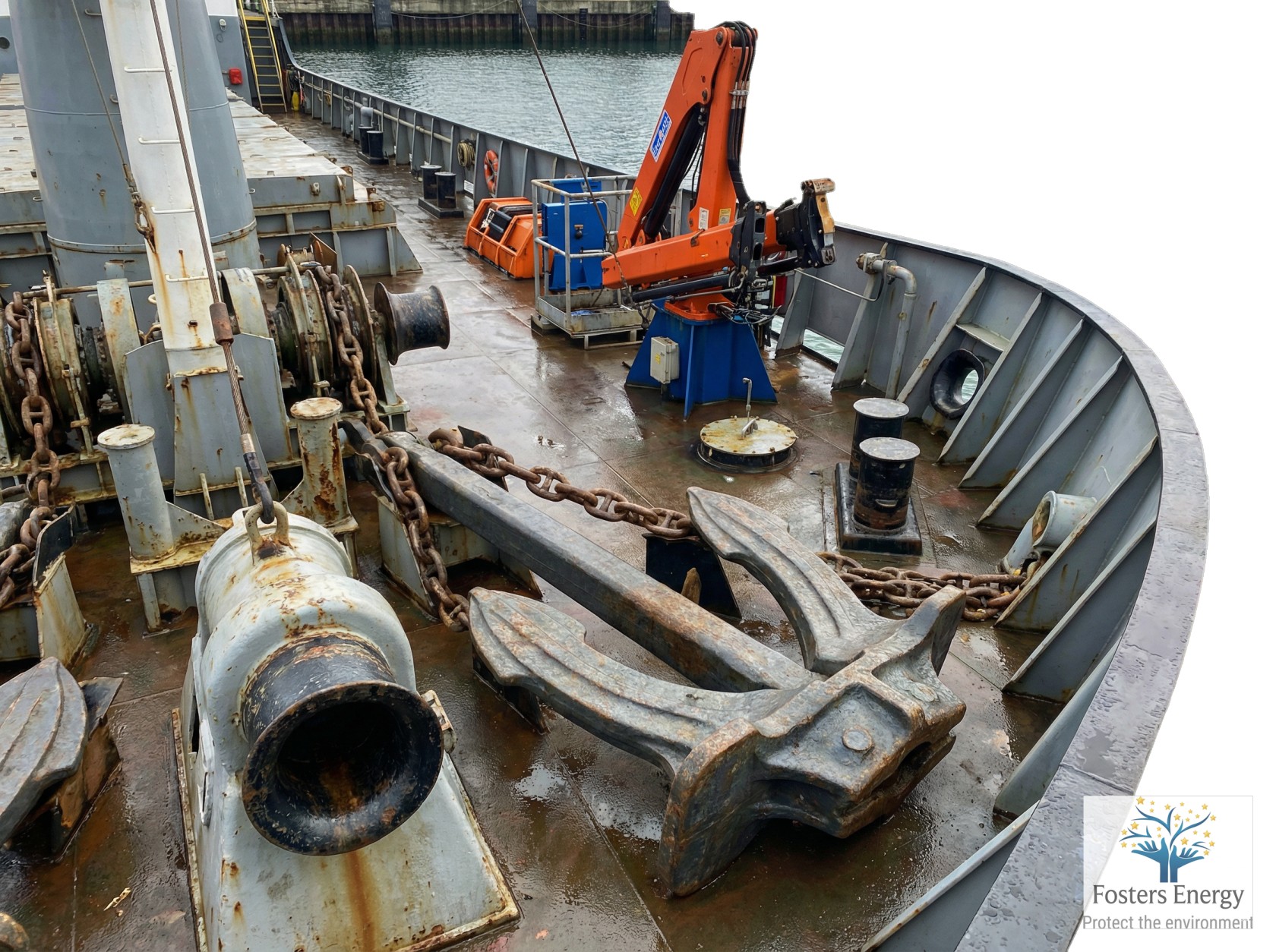
Ship anchors are primary holding devices used to secure a vessel in position when mooring to fixed infrastructure is not available or when operational waiting, standby, or transfer conditions require controlled station holding. Their function depends on interaction with the seabed and the anchoring system as a whole. The anchor must penetrate or engage the seabed effectively, develop holding resistance under the applied load path through the chain, and maintain stability as environmental forces act on the vessel.
From an engineering perspective, a ship anchor is part of a complete operational chain that includes release control, lowering behavior, seabed engagement, holding development, retrieval performance, and repeat-cycle durability. Effective anchor performance therefore depends not only on the anchor itself, but also on how well the product suits the vessel’s equipment, route conditions, and operating practices.
Key performance considerations
For marine operators evaluating ship anchors, several factors define product value. Holding capability is fundamental, but it must be considered alongside controlled handling and structural reliability. The anchor should maintain dimensional integrity and dependable surface condition under marine exposure, resist premature deterioration, and support repeated use without creating avoidable difficulty for the crew or anchor-handling equipment.
Another important consideration is recovery behavior. An anchor that holds effectively but creates inefficient retrieval patterns can still reduce operational performance. The best product outcome is a balanced one: dependable holding, efficient deployment, stable alignment with the anchoring arrangement, and practical recovery characteristics that support vessel turnaround.
Benefits
Improved operational predictability
When ship anchors are correctly selected for marine duty, crews can execute anchoring operations with greater confidence and consistency. Predictable deployment and holding behavior reduce the need for repeated maneuvers and lower the chance of losing time during positioning. This benefits vessels operating on tight schedules or working in areas where windows for anchoring and recovery are limited.
Reduced deck handling risk
An anchor arrangement that behaves consistently is also a safer one. Controlled lowering, dependable seating, and stable recovery reduce unnecessary intervention by deck personnel. This is important because anchoring operations involve concentrated mechanical force, moving equipment, and environmental variability. Optimization is therefore closely linked to safer deck routines and reduced exposure during anchor handling.
Lower avoidable equipment stress
Improved anchor performance can also reduce avoidable loading on associated equipment such as windlass systems and chain handling components. When the anchor deploys and recovers as expected, the full anchoring system experiences fewer irregular events, which can help support maintenance discipline and reduce the likelihood of accelerated wear caused by repeated abnormal handling.
Better lifecycle value
Marine operators do not optimize by focusing on purchase cost alone. Lifecycle value depends on service durability, reduced interruption, stable performance, and compatibility with vessel operations. A ship anchor that supports efficient anchoring over extended service intervals can contribute to lower operational friction and better asset reliability over time.
Applications in Marine
Ship anchors are relevant across a wide range of marine applications. Commercial cargo vessels depend on them for controlled holding outside port areas and during schedule transitions. Offshore support vessels rely on anchoring reliability when waiting on assignment, supporting nearshore activities, or operating in variable marine environments. Harbor craft and service vessels benefit from efficient anchoring where repeated deployment and retrieval are part of normal operations.
Anchors also remain important in coastal transportation, marine utility work, and vessel support roles where infrastructure access is limited or operational flexibility is required. In all of these cases, the anchor contributes directly to the vessel’s ability to maintain control, manage time effectively, and reduce operational uncertainty during non-berth holding conditions.
For marine operators working in demanding regional conditions, anchoring hardware must support real service behavior rather than nominal specification only. Product suitability influences how the vessel performs when sea state, current variation, seabed condition, and duty frequency place pressure on the anchoring system. This is where engineering-oriented supply support becomes valuable.
Why Fosters Energy
Fosters Energy serves the marine sector as an engineering solutions provider with practical knowledge of equipment performance and service expectations. The company’s broader portfolio covers marine systems, flow equipment, heat exchangers, environmental systems, and essential industrial products used in vessel and offshore operations. Within that context, ship anchors are supplied as part of a marine offering shaped by operational relevance rather than generic sales language.
The company’s website emphasizes engineering support, service benchmarking, audits, equipment observation, and experienced technical personnel. That positioning matters because marine operators need suppliers who understand how equipment performs in service. For ship anchors, the value lies in aligning product supply with vessel application, operating demand, and the requirement for dependable day-to-day marine execution.
Fosters Energy is therefore well positioned to support clients seeking marine products that contribute to operational optimization. The focus is not on exaggerated claims, but on practical equipment selection, credible support, and solutions that fit the realities of marine duty.
Conclusion
Ship anchors remain essential to marine performance because they influence safety, holding reliability, schedule control, and the efficiency of routine vessel operations. In modern marine service, operational optimization depends on reducing variability in every critical function, and anchoring is one of those functions. A properly selected anchor supports stable holding, smoother handling, reduced equipment stress, and more predictable vessel operation under real marine conditions.
For operators who want to improve anchoring performance, product choice should be based on engineering practicality, not only general specification. When anchor supply is aligned with vessel requirements and operational duty, the result is better control over a task that directly affects marine readiness and performance. Fosters Energy supports this approach by providing marine equipment solutions grounded in technical understanding and operational relevance.